

Key Takeaways
Moving to Austin TX in 2026 still rewards buyers who match the right suburb to their budget, commute, and stage of life.
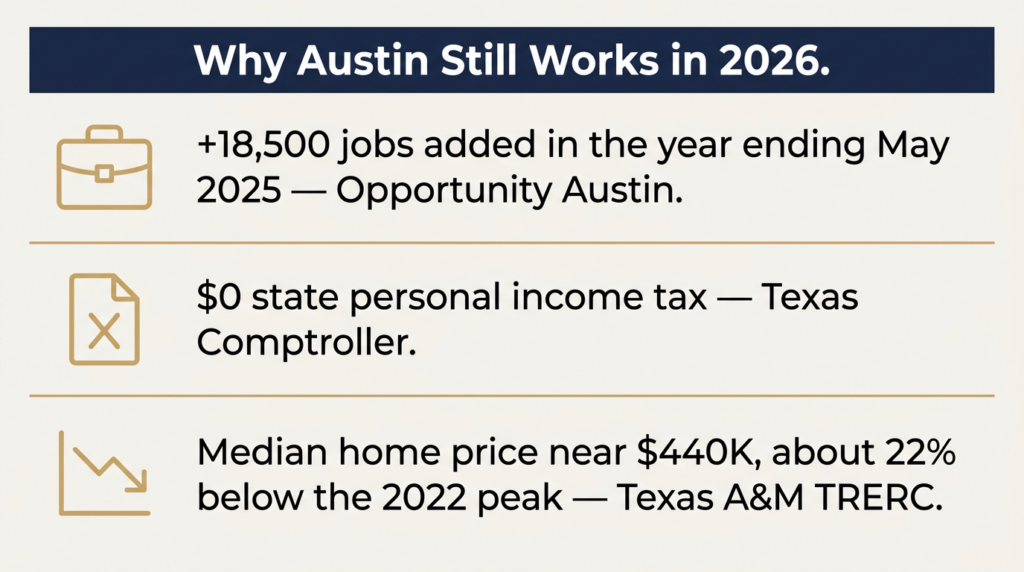
- The Austin metro added roughly 18,500 jobs in the year ending May 2025 and ranks among the top 10 of the 50 largest U.S. metros for growth, according to Opportunity Austin, keeping employer demand steady.
- Texas charges no state personal income tax, and the 2025 homestead exemption increase to $140,000 sharpens the affordability math for relocating households.
- Prices have cooled. The Austin-area median home price settled near $440,000 by mid-2025, down about 22 percent from the 2022 peak, which hands buyers real negotiating room.
- The suburb you choose matters more than the city name on the map, because schools, commute times, and home age vary sharply across the metro.
Start by matching a suburb to your commute and family needs, then decide between new construction and resale before you ever tour a single home.
If you are moving to Austin TX in 2026, you are joining one of the most-researched relocations in the country, and the smartest buyers treat it like a research project rather than a leap of faith. The good news for newcomers is that the fundamentals still hold. According to Opportunity Austin, the region added about 18,500 jobs in the year ending May 2025 and ranked among the top 10 of the 50 largest U.S. metros for job growth, with unemployment sitting near 3.5 percent. That steady employer base, anchored by names like Dell, Apple, Samsung, and Tesla, is what keeps drawing people here.
This moving to Austin guide walks through the practical decisions in order, so you can move from “somewhere in Texas” to a specific neighborhood with confidence. Think of it as the relocating to Austin reference you wish a local would simply hand you. For a quick orientation to new-construction options before you read on, you can also explore what a local Austin-area builder offers across the metro.
Is Austin Still a Good Place to Move in 2026?
Yes. For most buyers, moving to Austin TX still makes sense, provided you go in with realistic expectations and a clear picture of the suburb you want. The job market remains broad, the tax structure favors earners, and the inbound migration that defined the past decade has not reversed. The Texas Real Estate Research Center at Texas A&M reports that Texas added 2.01 million residents between 2020 and 2024, with 76 percent of that growth coming from net migration. People are still choosing Texas, and the Austin metro continues to capture a large share.
What changed over the past few years is the pace. The frenzied seller’s market of the early 2020s has cooled into something more balanced, which is good news for anyone relocating to Austin. Buyers now have more time to tour, compare, and negotiate than they did when homes sold in a weekend. The same research center notes that Austin led the state’s price correction, with the area median settling near $440,000 by mid-2025, roughly 22 percent below the 2022 peak. For a buyer, a cooler market means leverage that did not exist a few years ago.
The honest caveat is that “Austin” means very different things depending on where you land. The urban core feels nothing like the master-planned suburbs to the north, and the Hill Country west of town feels different again. That is why this living near Austin decision is really a series of smaller decisions about commute, schools, and the kind of daily life you want.
What Does It Really Cost to Move to Austin TX?
Cost is where relocation math gets real, and it is where out-of-state buyers are most often surprised, in both directions. Housing costs more than many newcomers expect from a Texas city, but the tax picture often offsets that. The goal of this section, and of this moving to Austin guide overall, is to give you the framework and the real numbers, not a single misleading average, because prices swing widely by suburb and home type.
How Do Texas Taxes Change the Math?
Texas levies no personal state income tax, a structural fact confirmed by the Texas Comptroller of Public Accounts. For households moving to Austin TX from high-tax states, this is the single biggest line-item swing in the relocation budget.
Here is an illustrative calculation rather than a claim about your specific situation. On a household income of $120,000, a state that levies a 5 percent income tax would collect roughly $6,000 per year. In Texas, that figure is $0 at the state level. Over five years, that is approximately $30,000 staying in your budget, money that quietly raises how much home you can comfortably carry.
The trade-off is property tax, which funds Texas schools and services and runs higher than in many states. The offset matters here too. As documented by Ballotpedia, Texas voters approved Proposition 13 in November 2025, raising the school-district homestead exemption from $100,000 to $140,000 for tax year 2025. On a primary residence, that exemption removes $140,000 of value from the school-tax portion of your bill. Smart buyers factor the property-tax line into their monthly payment from the start and file the homestead exemption as soon as they close.
What About Housing and Everyday Costs?
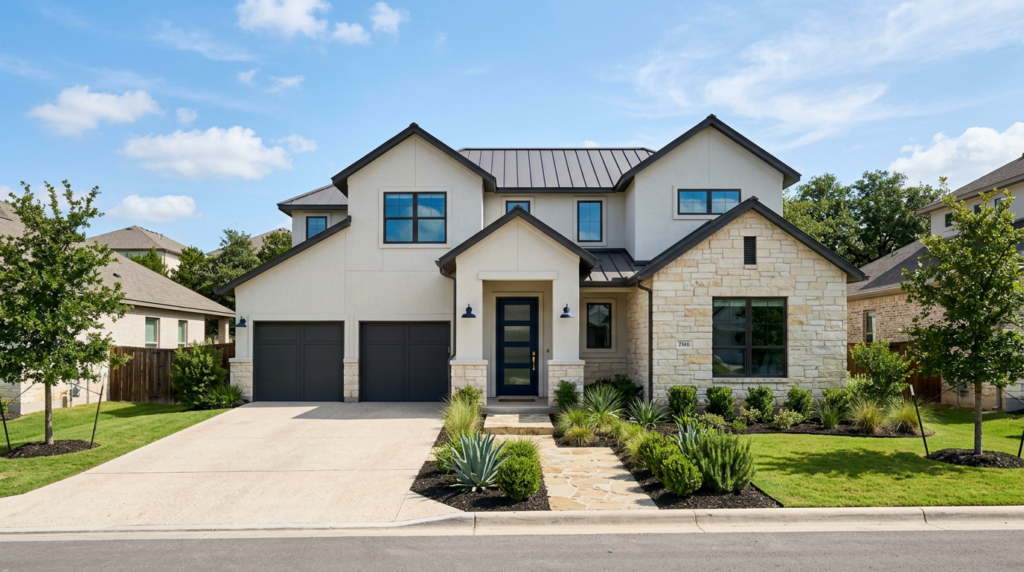
Home prices in the Austin metro vary so widely by suburb that any single “average” is close to meaningless for a buyer. A gated community in the Hill Country and an established neighborhood east of I-35 sit in entirely different price tiers. The practical move is to anchor your search to a specific suburb and home type, then build your budget around that.
Everyday costs sit closer to the national picture than the housing figures suggest. A few realities worth planning for:
- Utilities, especially summer cooling, run higher than in cooler climates because Central Texas summers are long and hot.
- Auto-dependence is real outside the urban core, so factor in fuel and a reliable vehicle for most suburbs.
- Childcare and dining have crept upward with the region’s growth, in line with other fast-growing metros.
Which Austin Suburbs Work Best for Families?
Families relocating to Austin tend to prioritize three things in roughly this order: schools, safety, and space for the money. For most households, living near Austin rather than inside the urban core is the trade that buys all three at once. Because schools top that list, it helps to know each suburb’s primary district up front: the official Pflugerville ISD and Leander ISD sites both publish their campus boundaries, and zoning can vary street by street, so confirm the specific campus before you commit. The metro offers strong options in every direction, but a handful of suburbs consistently rise to the top for households with kids. Below is a practical shortlist, ordered to help you narrow quickly rather than ranked as a strict hierarchy.
- Pflugerville sits just northeast of Austin and pairs an easy tech-corridor commute with a community-centered feel and dual school-district zoning. It is a common landing spot for young families who want value without a long drive to work.
- Round Rock offers a deep local job base anchored by Dell Technologies, established retail, and a well-regarded district, making it a steady choice for families who want everything close at hand.
- Cedar Park and Leander to the northwest deliver newer housing stock, growing amenities, and quick access to the tech employers along the northern arc of the metro.
- Georgetown, at the metro’s northern edge, blends a historic square with rapid new-home growth for families who want small-town texture with big-city access.
- Spicewood and the Lake Travis corridor to the west suit move-up families drawn to Hill Country living, larger lots, and lake access, trading a longer commute for space and scenery.
The table below pairs each suburb with its primary school district, the detail families most often verify first. Zoning can split across districts at the edges, so treat it as a starting point rather than a guarantee for a given address.
| Suburb | Primary school district | Direction from Austin |
|---|---|---|
| Pflugerville | Pflugerville ISD | Northeast |
| Round Rock | Round Rock ISD | North |
| Cedar Park / Leander | Leander ISD | Northwest |
| Georgetown | Georgetown ISD | North |
| Spicewood / Lake Travis | Lake Travis ISD | West |
For families weighing two of these areas directly, our deeper guides to nearby Austin suburbs can help you pressure-test the trade-offs.
Where Should Commuters Live Near Austin?
Commute is the factor newcomers most often underestimate, and it is where local knowledge pays off. The right answer to “where should I live” depends almost entirely on where you will work, because the metro’s major employers are spread across very different corners of the map.
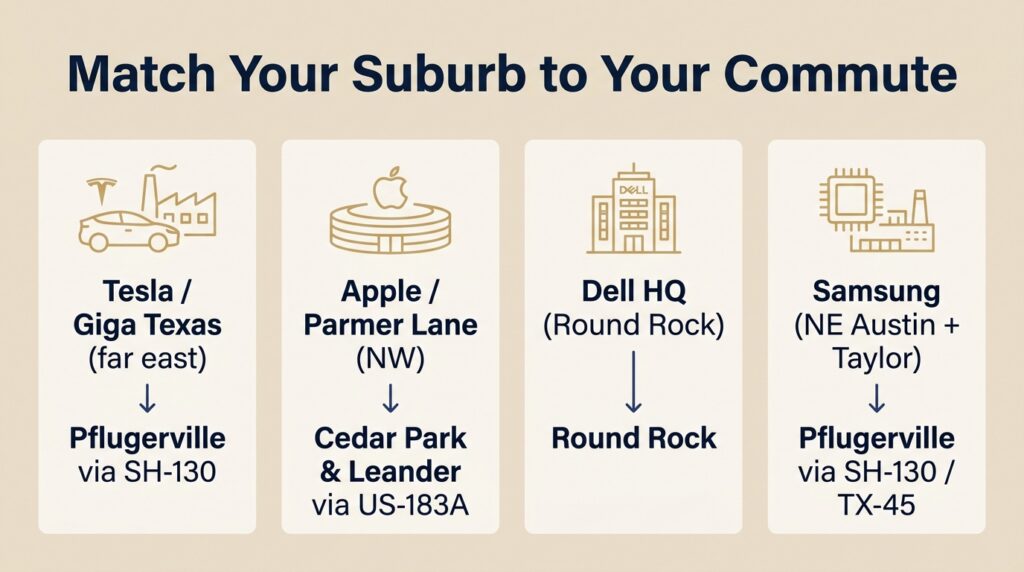
A few anchors worth knowing if you are living near Austin and commuting to a tech campus:
- Tesla’s Giga Texas sits in far east Austin near the airport, reached quickly from eastern suburbs via the SH-130 toll road.
- Samsung Austin Semiconductor runs its longtime fab in northeast Austin, and Samsung’s official plans add a major new facility in nearby Taylor, set to open in 2026.
- Apple’s campus sits in northwest Austin along Parmer Lane, convenient to the northern suburbs.
- Dell Technologies is headquartered in Round Rock, making the northern corridor a natural fit for its workforce.
For a Pflugerville buyer, the SH-130 toll road offers a direct eastern route toward the Giga Texas area, while TX-45 and US-183 keep the northern tech campuses within reach. Matching your home to your specific commute corridor, rather than to a general sense of “north” or “east,” is the move that prevents commuter regret a year into the relocation. Test-drive the drive at rush hour before you sign anything.
Should You Buy New Construction or a Resale Home?
This is the fork in the road for most relocating buyers, and there is no universally right answer, only the answer that fits your timeline, tolerance for projects, and priorities. Resale homes can offer mature trees, established neighborhoods, and occasionally a lower entry price. New construction offers current floor plans, modern energy efficiency, warranty coverage, and the ability to move into a finished home without inheriting someone else’s deferred maintenance.
What New Construction Offers Relocating Buyers
For out-of-state buyers especially, new construction removes a layer of risk. You are not flying in to compete on a 1990s home with unknown roof age and a kitchen you will want to gut. A move-in ready home in a gated community with a builder warranty lets you plan the relocation around a known move date and a known condition.
The table below frames the core trade-offs.
| Factor | New construction | Resale |
|---|---|---|
| Move-in condition | Finished, move-in ready | Varies, may need work |
| Floor plans | Current layouts | Older layouts common |
| Energy efficiency | Built to modern code | Often dated |
| Warranty | Builder warranty included | Typically none |
| Neighborhood maturity | Newer, growing | Established |
Where Do New Communities Fit Different Buyers?
This moving to Austin guide keeps returning to two buyer profiles, and they map cleanly onto two community types. Tech professionals and young families targeting the high $300s to $400s and a short tech-corridor commute gravitate toward gated, thoughtfully designed homes in Pflugerville such as Cielo, with its dual Pflugerville and Round Rock school-district zoning and quick access to Dell, Samsung, and Apple. Move-up buyers seeking space, craftsmanship, and Hill Country living near Lake Travis lean toward gated enclaves like Brahmans Draw in Spicewood, where larger floor plans and lake-and-golf proximity define daily life. Knowing which profile fits you narrows the entire search quickly.
Frequently Asked Questions About Moving to Austin TX
Is moving to Austin TX still worth it in 2026? For most buyers, yes. The job market remains broad across multiple industries, Texas charges no state income tax, and prices have eased from their 2022 peak. That combination gives buyers more room to tour and negotiate than they had a few years ago.
What salary do you need to live comfortably near Austin? There is no single number, because cost depends heavily on the suburb and home type you choose. A practical approach is to pick your target suburb first, build a monthly budget that includes the property-tax line, and work backward to the income that supports it comfortably.
Which Austin suburb is best for tech workers? It depends on your campus. Pflugerville suits commuters heading to Tesla’s Giga Texas via SH-130 while keeping northern campuses reachable, Round Rock fits Dell employees, and the northwest suburbs serve the Apple corridor along Parmer Lane.
Is it better to buy new construction or resale when relocating? For out-of-state buyers, new construction often reduces risk: a finished, move-in ready home with a builder warranty and a known move date avoids bidding wars and the deferred maintenance common in older homes.
How much can I save on taxes by moving from a state with income tax? The savings can be meaningful. On a $120,000 income, a 5 percent state income tax would cost roughly $6,000 a year, which is $0 in Texas at the state level. Property taxes here are higher, but the 2025 homestead exemption of $140,000 softens that, so weigh both sides in your monthly math.

Plan Your Austin Move Around the Right Community
The buyers who relocate happily are the ones who reverse the usual order: they choose the commute, the schools, and the home type first, and let those decisions point them to the right neighborhood. If you are moving to Austin TX in 2026, that discipline is your biggest advantage in a metro this varied.
Whether you are a tech professional eyeing a gated community near the northern campuses or a move-up buyer drawn to Hill Country living near Lake Travis, the right new-construction home turns a stressful relocation into a confident one. Keystone Homes builds in both of those worlds, with thoughtfully designed, move-in ready communities across the Austin metro. To talk through which one fits your move, reach out to our team and let us help you land in the right place.